
Between Discourse and Morality: On Progressive Silence in the Face of Iran

The Western student and the legacy media that remain silent in the face of the killing in Iran are not experiencing mere intellectual confusion.
What the student faces is a destabilization of the position from which he is accustomed to situating himself as a moral subject.
The revolution in Iran functions like a magnet near a compass. Suddenly, all the emotional, linguistic, and identity tools into which the student was socialized, and which previously enabled him to act, cease to function.
The subject is never the source of his own sovereignty. He is formed within language, within a symbolic order, and he acts in anticipation of recognition from the Other. This Other is not a particular individual, but a system of authorities, values, norms, and modes of discourse. For the student, this Other is embodied in academia, in critical theory, in the progressive collective.
When this Other provides a clear framework, the subject operates with relative ease. He knows how to speak, how to protest, how to position himself on the moral side. Action is not experienced as an existential effort but as alignment. It provides a sense of belonging and stability.
The situation in Iran, however, produces a failure in this mechanism. A moral intuition that cannot be denied collides with a progressive conceptual world incapable of containing the situation. The oppressed Orientalist subject turns out to be the oppressor.
Conceptual dogmatism encounters a reality that exceeds it. Suddenly there is no established language that situates the event within the familiar dialectic of oppressor and oppressed. The subject discovers that the authority on which he relied is incomplete.
This encounter with absence generates anxiety. Not anxiety in the face of violence in Iran, but identity anxiety arising from the need to articulate a moral position without symbolic backing. Taking a position under such conditions requires assuming subjective responsibility, that is, acting without full reliance on a ready-made discourse. For progressives, this is a threatening step.
The false self that developed as an adaptation to the expectations of the environment, and that enables smooth functioning within existing frameworks, becomes unsettled when it is forced to think independently. In Winnicott’s terms, this is the point at which the true self appears, when there is no clear script within which one is meant to act.
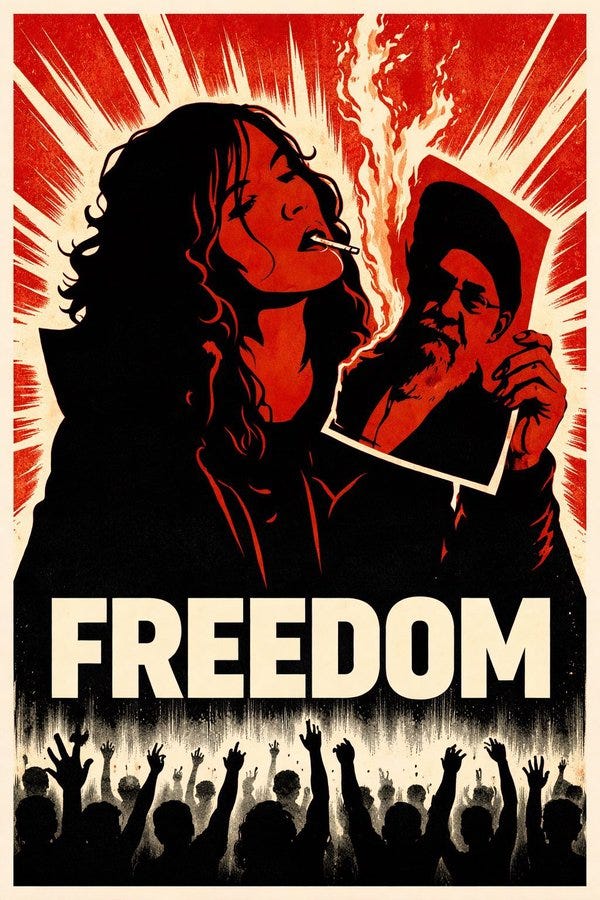
The student operates through a well-functioning false self. He knows what to say and how to appear moral.
But the events in Iran shatter the familiar script. There are no stable slogans through which reality can be grasped. In such a situation, contact with the true self is required, with a position that is not rewarded as enlightened by the surrounding environment. Moral paralysis and silence function as defense mechanisms of the false self against total collapse.
Within the ideology the student has internalized, the human being does not appear as a concrete and real individual, but as a theoretical representation bearing an identity he did not choose. He is always defined a priori through the group to which he belongs. When reality exceeds theory, it becomes unclear how to relate to the concrete person fighting for freedom. As a result, the Iranian victim does not appear as a living moral figure, but as an unresolved conceptual problem.
Silence on campus is therefore not merely a descriptive failure but a moral one. It testifies to a form of consciousness that has lost its capacity for judgment once the organizing discourse disappears. A position that speaks in the name of morality yet can act only when supported by a closed ideological lexicon is not a moral position. It is a technique of belonging and loyalty. When a direct human response to a concrete individual struggling for freedom is required, such consciousness becomes paralyzed. This is not because reality is unclear, but because morality has been replaced by loyalty to a distorted discourse.
Iran thus reveals not a practical error but the limitation of progressive ideological discourse itself, a discourse that does not merely fail in this case, but proves incapable of serving as a foundation for moral consciousness in general.
Kant taught: act only according to that maxim that may be simultaneously willed as general law. His meta-ethic seems to be stronger than the ethic of reciprocity (as instantiated in the familiar silver and golden rules); rather, the same principle must be applied consistently.
Academics, educators, influencers, public figures of all sorts have taught us that our job is affirmation of the wildest fantasies, instead of arriving at the objective truth through observation and reason. No wonder the campuses are silent, if not hostile, to supporters of the Iranian people.